
Wanted Win guide for Australia
Wanted Win KYC and Verification
 Available in AU
Wanted Win can require identity verification as part of account controls and before processing withdrawals. The current AU-facing KYC page lists a valid passport or other identification paper, proof of address, the player’s name, residential address and valid email, and says the operator can request additional documentation. The current Terms also mention government-issued photo ID, proof of address and possible proof of the payment method.
The same KYC page currently says consideration of documents “could be up to 30 working days” from the point when all requested documents are provided. That is an operator-published maximum-review statement, not a promised completion time. A specific case can depend on whether the documents are complete, readable and consistent with the account. For monetary withdrawal limits and operator processing targets, use the separate withdrawal rules.
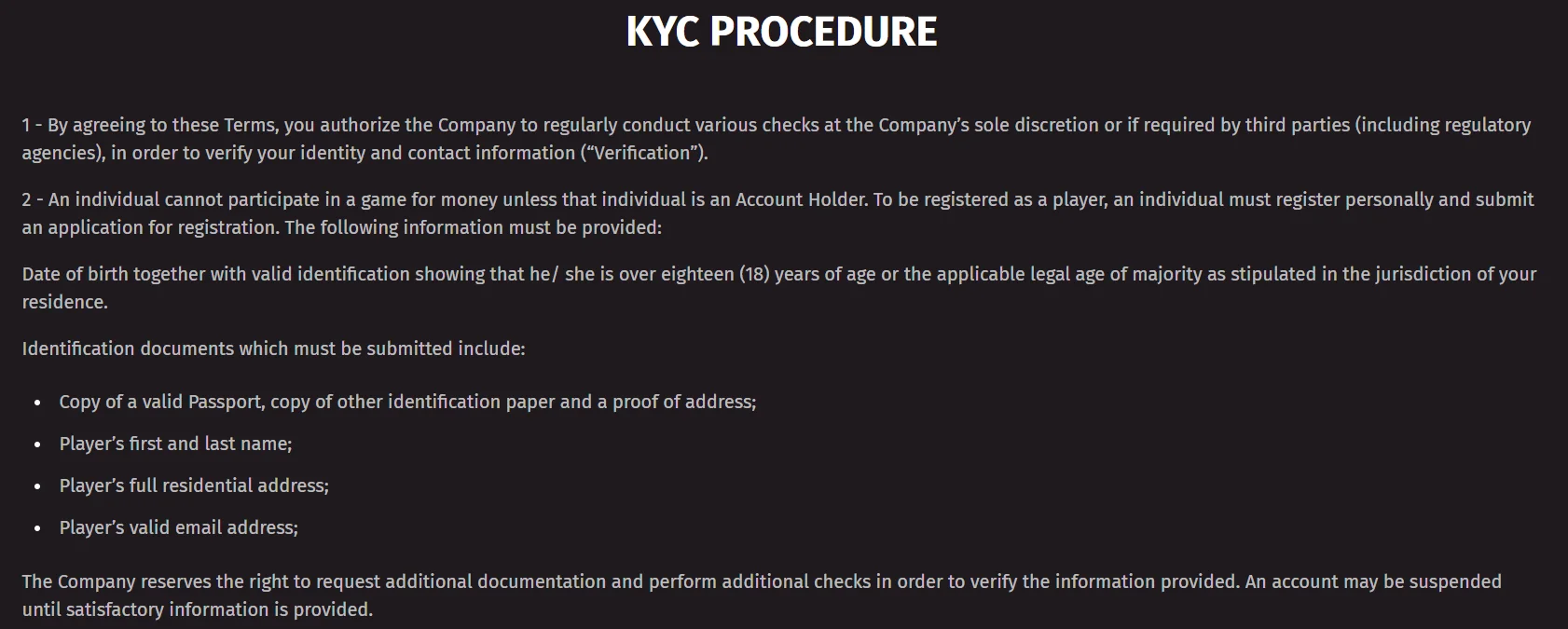
Table of Contents
- What Wanted Win currently asks for in KYC
- Why KYC can appear after registration
- The 30-working-day statement is not a payout promise
- How to reduce avoidable verification delays
- Payment-method checks can be part of identity verification
- What happens if the information does not match
- KYC and Australian regulatory status are different questions
- How Wanted Win verification can affect Australian withdrawals
What Wanted Win currently asks for in KYC
Identity verification is not described as a single universal upload list that will be identical for every account. The current KYC page gives core categories and reserves the right to ask for more information or checks where needed.
| Category | Current operator wording supports | What to check before submitting |
|---|---|---|
| Identity | Valid passport or other identification paper; the Terms also name government-issued photo ID such as a passport or driver’s licence. | Name and date of birth should match the account details and the document should be valid. |
| Address | Proof of address; the Terms give utility bill or bank statement as examples. | The address should match the residential address recorded on the account. |
| Contact details | Full name, full residential address and valid email are part of the KYC information set. | Correct inconsistencies through normal account/support channels rather than submitting conflicting information. |
| Payment information | The Terms say proof of payment method can be requested as additional documentation. | Follow the specific request and protect information that the operator does not ask to see. |
| Additional checks | The operator reserves the right to request further documents or conduct additional checks. | Treat the request as account-specific rather than assuming another user’s checklist will be identical. |
The important practical distinction is between document categories and a guaranteed checklist. The first is supported by current operator material. The second is not: Wanted Win explicitly keeps discretion to ask for more information.
Why KYC can appear after registration
The registration and account setup guide covers the information used to create an account. KYC is a later or continuing verification layer. Wanted Win’s Terms say that by registering and using the website, the player authorises identity and contact-information checks at the operator’s discretion or where required.
That means a registration form accepting your details should not be read as permanent approval of those details. The operator may ask for documents when reviewing the account, when a payment raises a verification question, or before a withdrawal is processed. The Terms specifically state that identity may be verified before withdrawals.
This separation explains why a player can use an account and still face a later document request. It also explains why keeping registration data accurate matters: the KYC policy says inaccurate, incomplete or misleading information, including registration data that does not correspond to passport data, can lead to account closure.
The 30-working-day statement is not a payout promise
As checked on 23 September 2026, Wanted Win’s AU-facing KYC page states that consideration timelines for KYC documents could be up to 30 working days from the moment the client has provided all requested documents. The wording matters. It is framed as a possible upper review period, not as a service-level guarantee that every case will take 30 days or finish earlier.
It also starts from a specific condition: all requested documents have been provided. If the operator asks for another document, needs a clearer copy, or identifies a mismatch, the practical verification timeline can be affected because the information set is not yet complete.
Do not merge this number with the operator’s separate withdrawal-processing language. A withdrawal can involve a KYC stage, an internal payout-processing stage and external bank, wallet or network settlement. Those are different clocks. The exact cashout limits and the current post-approval processing target are kept on the cashout and KYC guide.
How to reduce avoidable verification delays
The goal is not to “beat” KYC but to avoid creating preventable inconsistencies. Use a current identity document, make sure the legal name and date of birth match the account, and submit an address document that corresponds to the recorded residential address. If the operator requests payment-method information, use the exact method tied to the account transaction.
Readable images matter. Cropped edges, glare, blurred text or images that omit the requested information can lead to another request. At the same time, do not send unrelated personal material merely because another review site lists it. The operator’s current request should define what is needed for that case.
If a document cannot be provided as requested, use the operator’s support or verification process to resolve it. Creating a new account, changing location signals, borrowing another person’s payment method or altering documents can introduce separate account-rule violations and does not make the original verification issue disappear.
Payment-method checks can be part of identity verification
Wanted Win’s Terms allow additional documents to confirm identity or a payment method. They also say deposits must come from a payment account registered in the player’s own name. Together, those rules make payment ownership a relevant KYC issue rather than a separate banking detail.
If a withdrawal follows a card, wallet, bank or crypto deposit, the operator may need information that the account holder and payment owner are the same person. The exact information can vary. That is why this page does not publish a made-up Australian card-photo checklist or tell users to expose full card numbers when no such specific request is stated in the current policy.
The practical approach is to preserve transaction records, keep account details consistent and follow the secure upload instructions supplied for the individual case. For which payment methods are broadly published and which are region-dependent, see the payments overview.
What happens if the information does not match
The current operator policies use strong language around inaccurate verification information. The KYC page says false, incomplete, inaccurate or misleading information can be treated as a terms violation. The Terms also say an account can be suspended or closed if requested documentation is not supplied or is invalid, including examples such as an expired ID or mismatched name and address.
Those consequences are the reason identity details should be corrected through normal account channels rather than worked around. A genuine spelling error or outdated address is a support problem to resolve, not a reason to create another identity or account.
Wanted Win also reserves the right to perform additional checks. This page therefore avoids promising that any particular document pair will always be enough. A passport and proof of address are core categories in the current policy, but a specific account can receive an additional request.
KYC and Australian regulatory status are different questions
KYC shows how the operator checks the identity of account holders. It does not establish that the operator holds an Australian licence or that Australian licensed-wagering consumer protection schemes apply. KYC requirements do not show whether a casino is licensed in Australia; check licensing separately.
The current Wanted Win material can support direct statements about its own KYC requirements. Australian licensing and ACMA context require regulator information and are handled on the licence and Australian rules page. Keeping those topics separate avoids using a common compliance process as a proxy for local legal status.
Likewise, a strict KYC process does not by itself prove that a casino is “safe”, and an inconvenient document request does not by itself prove that it is a “scam”. Those broad labels collapse several different questions – identity controls, licence jurisdiction, payment performance and complaint history – into one unsupported verdict.
How Wanted Win verification can affect Australian withdrawals
KYC can become a gating step for a withdrawal because Wanted Win reserves the right to verify identity before processing payouts and can keep an account suspended while required information is outstanding. The current document categories are government photo identification, proof of address and, where requested, additional identity or payment information. The AU KYC page currently states that review can take up to 30 working days after all requested documents are supplied, but that is a published maximum-review statement rather than a guaranteed timetable.
For an Australian user, the useful preparation is straightforward: keep account identity data accurate, use payment methods in your own name, respond to the actual verification request with readable current documents, and separate the KYC clock from the operator’s later withdrawal-processing and bank-settlement stages. For a wider view of the brand, return to the Wanted Win Australia review.
Created by the ”Wantedwin Casino” editorial team.